
// The SME Creative Hub
Creative Clarity for SMEs

AI vs human creativity in SME branding

How Do I Get My Business to Show Up in AI Search Results?

Stop chasing search hacks. Start becoming easier to understand.
‍
Reading time: 5 min

// Introduction

AI search has created a new rush for shortcuts.

- How do I rank in ChatGPT?
- How do I appear in Google AI results?
- Do I need GEO?
- Should I change my Google Business Profile?
- Should I create more location pages?
- Should I copy the keywords my competitors rank for?

For SMEs already trying to understand SEO, websites and content marketing, it can feel like another system that needs to be cracked.

But that thinking creates a bigger problem.

Every shortcut needs another adjustment later.
Every platform change creates another fix.

And businesses can spend years chasing visibility without becoming particularly clear about what they actually want to be known for.

// Question

How do we trick AI into finding us?

That’s not the most helpful question — but it’s becoming one of the most common questions.

The better question is:
‍How do we make our business clear, relevant and useful enough to be worth finding?

Because being found gets you seen.
Being understood gets you chosen.

// Question

Do SMEs Need a Special AI Search Strategy?

No.

The fundamentals have not disappeared.

Your website still needs to be accessible, technically sound and understandable to search engines.

But there is no magic AI button that suddenly makes a business authoritative.

Google’s own guidance around AI search continues to emphasise useful, reliable content and genuine expertise rather than special AI-only optimisation tricks.

And ChatGPT search still needs to be able to access and understand the public information on your website before it can potentially surface it.

So yes, technical foundations matter.

But they are the starting point.
Not the strategy.

// Fact

When the Quick Fix Becomes the Forever Fix

Search marketing has always attracted shortcuts:

- Repeat the keyword more often.
- Add more locations.
- Change a Google Business Profile field.
- Find the competitor ranking above you.
- Copy their page structure.
- Buy another SEO tool.
- Create whatever page the software says is missing.

Some optimisation is useful. The problem begins when optimisation becomes the business strategy.

Because you never actually arrive anywhere.

There is always another keyword.
Another competitor.
Another tool.
Another algorithm change.
Another fix.

You become dependent on reacting to the system instead of building something the system can recognise you for.

‍The short-term fix becomes the forever fix.

// Fact

Copying Competitors Doesn't Help You Own a Subject

Competitor research is useful.
It tells you what is already happening in the market.

But it cannot tell you what your business should become known for.

If five companies use the same SEO software, discover the same keyword opportunity and create broadly the same article, none of them has created real authority.

They have simply filled the same space.
‍
That becomes even more important as AI-generated content makes it easier to reproduce what already exists.
‍
The opportunity for SMEs is not to say more of the same thing.

It is to contribute something useful that comes from:
- genuine experience
- real customer questions
- specialist knowledge
- completed projects
- a clear point of view

That is much harder to imitate.

// Insight

Own a Subject, Not Just a Keyword

This is where modern search becomes more interesting.

A business does not usually have expertise in one search phrase.

An architect may understand planning, extensions, listed buildings, interiors, materials and project costs.

A chiropractor may understand pain, mobility, rehabilitation and long-term movement.

A specialist animal therapist may work across physiotherapy, osteopathy, holistic treatment and rehabilitation.

Those subjects connect.
‍
When the website explains those relationships clearly, it begins to create context around what the business genuinely knows.

That is far more valuable than endlessly trying to rank one page for one phrase.

// Fact

AI Search Needs the Same Clarity Your Customers Do

A search system trying to understand your business needs many of the same answers as a potential customer.

- What do you do?
- Who do you help?
- What problems do you solve?
- Where do you work?
- Why are you credible?
- What makes your approach different?
- What evidence supports what you say?

If your website struggles to answer those questions, another optimisation tool will not solve the underlying problem.

This is where clarity becomes part of search strategy.

Not because clarity is an SEO trick. Because clarity helps people — and systems — understand what your business is actually relevant for.

// Insight

Show Evidence, Not Just Claims

Anyone can publish:
We are experts.

‍
That does not prove very much.

A stronger business presence demonstrates:
- Expertise through real work.
- Case studies.
- Customer questions.
- Useful articles.
- Qualifications.
- Experience.
- Examples.
- Specific answers to genuine problems.

That creates something search systems can reference and customers can trust.

The important question is gradually becoming less:
‍Where do I rank?

‍
and more:
‍When somebody asks about this subject, is my business useful enough to be part of the answer?

// Example

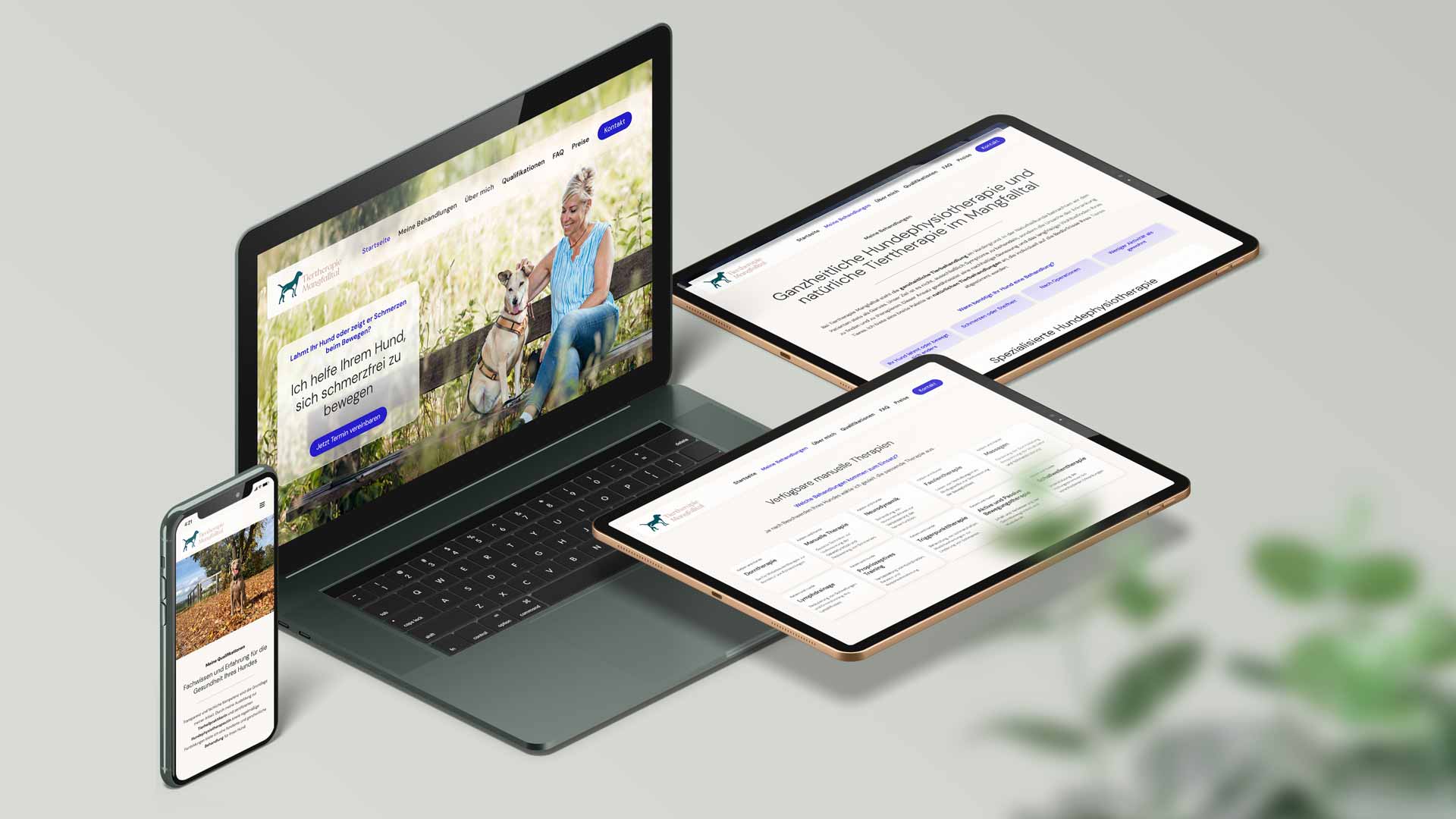
Case in Point: Tiertherapie Mangfalltal

Tiertherapie Mangfalltal is a small holistic animal therapy practice in Bavaria.

The challenge was not simply to put a website online or repeat one valuable keyword often enough.

The practice offers several specialist treatments, so the more important job was to make those services clear enough for pet owners to understand how they relate to their animal's needs.

The latest six-month Google Search Console data gives us a useful indication of what happened.

The website generated 4,240 search impressions and 158 clicks during the period. More importantly, discovery was spread across a range of relevant subjects rather than relying on one search phrase.

For example, the site recorded average Google positions of:
- 1.87 for “Tierheilpraktiker in der Nähe”,
- 2.18 for “Physiotherapie Hund in der Nähe”,
- 2.92 for “Tierphysiotherapie”
- 1.67 for “Hundeosteopathie in der Nähe.”

It was also being shown for broader searches around holistic animal treatment, natural animal treatment, mobile animal therapy and animal therapy generally.

That does not prove the site has somehow cracked AI search.

It demonstrates something much more useful.

The spread of search queries suggests Google is beginning to associate the website with a connected area of relevant expertise.

Different treatments.
Different questions.
Different searches.
One coherent business.

That is a much stronger foundation for future search visibility than continually trying to find the next optimisation trick.

// Question

So What Should SMEs Actually Do?

- Make your business difficult to misunderstand.
- Explain your services properly.
- Answer the problems customers genuinely ask about.
- Create pages with a clear purpose.
- Show real work and real expertise.
- Connect related subjects naturally.
- Keep your business information accurate.
- And continue building useful knowledge around the areas where you genuinely have something worth contributing.

It is slower than a hack.
But it also creates something you can own.

// Outcome

The Goal Isn't to Look Optimised

Customers do not choose a business because its website passed an SEO audit.

And search systems are not ultimately trying to reward whichever business bought the most optimisation software.

They are trying to resolve a question:
- A need.
- A problem.

Your job is to make the connection between that problem and your expertise unmistakably clear.

// Conclusion

- AI search will change.
- Google will change.
- ChatGPT will change.
- And the tools promising to optimise businesses for them will change too.

Building your strategy around every new trick means spending the future reacting.

There is another route:
‍

- Become useful around the subjects your business understands.
- Explain them clearly.
- Show evidence.
- Connect the knowledge.
- Build a recognisable point of view.

Because businesses do not create authority by constantly adjusting themselves to search.

They create it by becoming known for something.

‍Don't chase the system.
Give the system something worth finding.

‍
And give the customer something worth choosing.

// Ready for Soul?

Is your business easy enough to understand to be found for the right reasons?

Explore how Soul helps SMEs create clearer websites, messaging and content that make their expertise easier to understand — for customers and search systems.
If you're ready to move beyond guesswork and build a brand that actually drives growth, we’d love to help.
Our address
30, ARTHURLIE STREET
BARRHEAD
GLASGOW, G78 2EW
SCOTLAND
Connect with us
LINKEDIN
INSTAGRAM